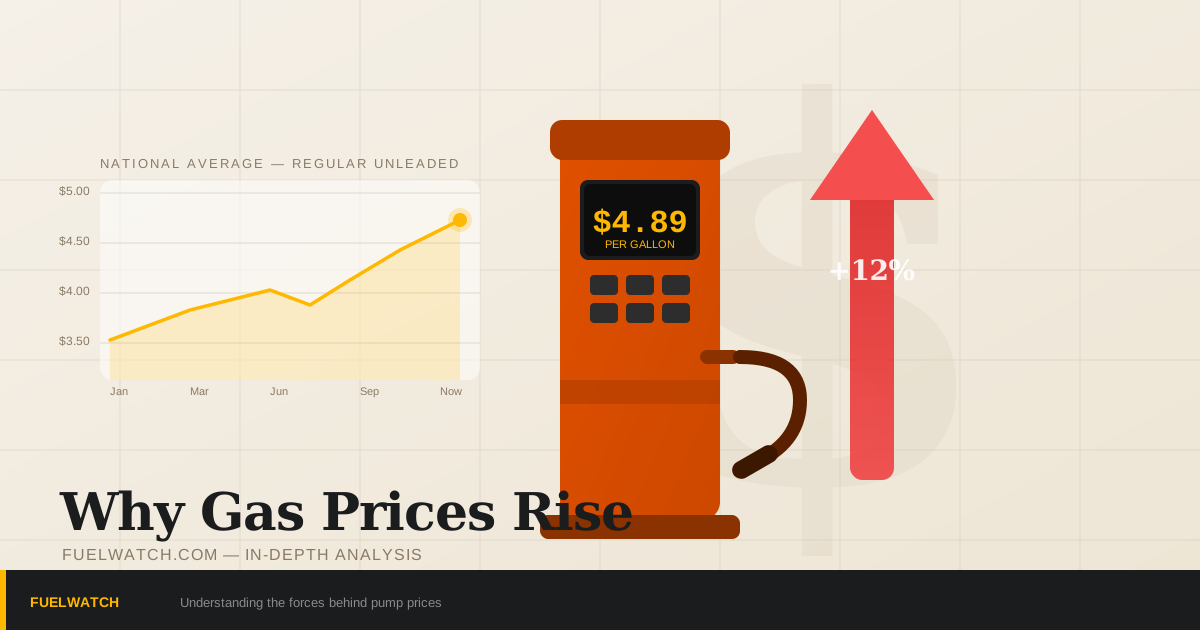
You pull up to the pump, look at the price board, and feel your stomach drop. It happened again. Gas is more expensive than last week — and nobody at the station can tell you why. You've probably heard the phrase "it's just supply and demand," but that explanation barely scratches the surface of what's actually driving fuel costs higher across the United States.
The truth is that retail gas prices are shaped by a web of interconnected forces: crude oil markets in Houston and London, production cartel decisions made in Riyadh, refinery fires in Louisiana, seasonal regulations in California, currency movements, and state tax policies. Understanding these forces won't lower your bill immediately, but it will help you anticipate price swings — and shop smarter when they hit.
This guide breaks down every major factor driving gas prices higher, backed by data from the U.S. Energy Information Administration (EIA), the American Automobile Association (AAA), and other authoritative sources.
The Price Breakdown: Where Every Dollar Goes
Before we can understand why prices rise, we need to understand what you're actually paying for. When you spend $4.00 at the pump, where does that money go? According to the EIA's regular price breakdown, the split typically looks like this:
What Makes Up the Price of a Gallon of Gas
On a $4.00 gallon, the approximate breakdown is:
- Crude oil: ~$2.12 (53%) — the raw material; set by global markets
- Refining: ~$0.64 (16%) — processing crude into usable fuel
- Distribution & marketing: ~$0.52 (13%) — pipelines, trucks, station costs
- Taxes: ~$0.57 (14–18%) — federal 18.4¢ + state average ~38.7¢
- Station margin: ~$0.15 (4%) — what the station actually keeps
"When crude oil prices rise 10%, retail gas prices tend to follow within two to four weeks — with the full transmission taking about a month." — American Petroleum Institute
Factor #1: Crude Oil — The Biggest Driver
Crude oil is the raw ingredient that refineries cook into gasoline, diesel, and jet fuel. Because it makes up over half the cost of a gallon of gas, even modest changes in crude oil prices ripple dramatically at the pump. Crude oil is priced on global commodity markets, with two primary benchmarks: West Texas Intermediate (WTI), the US standard, and Brent Crude, the international benchmark.
When traders and investors believe supply will be tight or demand will surge, they bid up crude futures — and refineries must pay those higher prices for their inputs, costs that get passed directly to consumers.
The Global Crude Oil Price Machine
Key facts about crude pricing:
- One barrel of crude oil = 42 gallons of liquid, yielding roughly 19–20 gallons of gasoline plus diesel, jet fuel, and other products
- Crude prices are set in real-time futures markets (NYMEX in New York, ICE in London) where millions of contracts are traded daily
- A $10 per barrel increase in crude typically raises retail gas prices by about 24 cents per gallon
- Geopolitical crises (wars, sanctions, supply disruptions) can spike crude by $10–25/barrel within days
- Major refineries buy crude 30–60 days before it arrives, meaning today's pump prices reflect decisions made weeks ago
"The crude oil commodity market is the single most important variable in US retail gasoline prices, accounting for more than half of what consumers pay." — EIA, Short-Term Energy Outlook
Factor #2: OPEC+ Production Decisions
The Organization of the Petroleum Exporting Countries (OPEC) and its Russia-led allies — collectively called OPEC+ — control approximately 40% of global crude oil supply. When this cartel decides to cut production, less oil reaches global markets, pushing prices up. When they increase output, prices tend to fall.
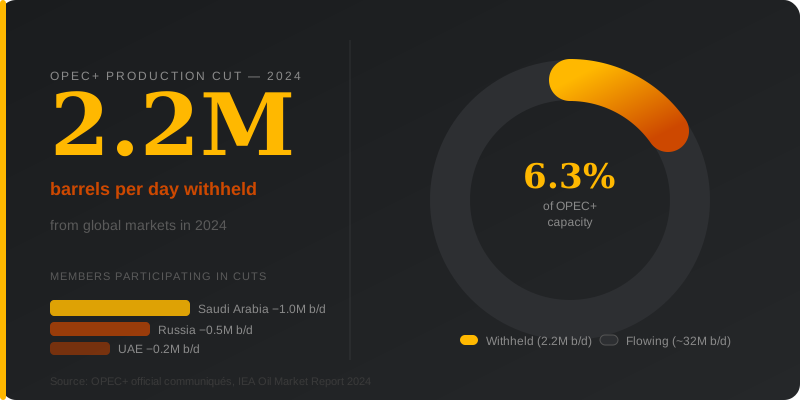
In 2023 and 2024, OPEC+ implemented a series of aggressive production cuts, led by Saudi Arabia's voluntary reduction of 1 million barrels per day on top of earlier collective cuts. These cuts directly inflated crude prices and, in turn, US gas prices.
OPEC+ Production Cuts: The Numbers That Move Your Pump Price
How OPEC+ directly affects US gas prices:
- Saudi Arabia's voluntary cut of 1 million barrels/day was extended multiple times through 2024
- Russia reduced oil exports by 500,000 barrels/day as part of the agreement
- The group controls production from 23 nations collectively producing ~40 million barrels per day
- Every 1 million barrel/day reduction in global supply is estimated to raise crude prices by $3–8 per barrel
- OPEC+ meetings (typically twice yearly) are closely watched by energy markets — rumors alone can move prices
"OPEC's cohesion and discipline in maintaining cuts have kept global oil markets tighter than they would otherwise be, providing a floor for oil prices well above $70 per barrel." — Goldman Sachs Commodities Research
Factor #3: Geopolitical Tensions and Supply Disruptions
Oil markets price in risk. Even when actual supply is uninterrupted, the possibility of a disruption can spike crude prices. The Russia-Ukraine war, conflicts in the Middle East, and US sanctions on Iran and Venezuela all constrain global supply or inject uncertainty that traders price into futures contracts.
How Wars and Sanctions Raise Your Gas Price
- Russia-Ukraine War: Russia produces ~10 million barrels/day. Western sanctions initially cut Russian exports, though much was rerouted to India and China. The uncertainty added $5–15/barrel to crude prices in 2022.
- Iran sanctions: US sanctions restricting Iranian oil exports remove roughly 1–1.5 million barrels/day from global markets. Iran's production capacity is ~4 million b/d but sanctions prevent full export.
- Middle East instability: The Strait of Hormuz — through which ~20% of globally traded oil passes — is a critical chokepoint. Any closure threat drives immediate price spikes.
- Libya and Nigeria: Both OPEC members with unstable output due to internal conflicts, regularly adding supply uncertainty.
"Energy markets are the most geopolitically exposed commodity markets in the world. A war that would be irrelevant to the price of wheat can send oil prices surging 20% in days." — Daniel Yergin, The New Map: Energy, Climate, and the Clash of Nations
Factor #4: Refinery Capacity and Seasonal Blends
Even if crude oil were free, refining it into gasoline has its own costs — and those costs spike seasonally. US refineries must produce different gasoline formulations depending on the time of year and geographic location. Summer-blend gasoline, required by the EPA in most metro areas from June through September, burns cleaner and reduces ozone — but it's significantly more expensive to produce.
Why Refineries Are a Hidden Price Driver
The refinery bottleneck explained:
- The US has approximately 130 operating refineries with a total capacity of ~18.8 million barrels per day — the world's largest refining system
- Refinery utilization runs 85–93% during peak summer demand; unplanned shutdowns immediately tighten supply
- Boutique fuels: The EPA requires approximately 20 different regional gasoline blends. California alone requires its own unique formulation that can only be produced by a handful of refineries. When a California refinery goes offline, prices spike locally because fuel can't easily be imported from other states.
- The transition from winter to summer blend typically raises pump prices by 20–40 cents per gallon each spring
- Hurricane season (June–November) threatens Gulf Coast refineries, which process nearly 50% of US fuel supply
- Since 2019, the US has lost significant refinery capacity — several facilities converted to renewable fuel production or closed entirely, tightening the overall system
Factor #5: Federal and State Taxes
Taxes are the most predictable component of gas prices — they rarely change — but their variation by state creates some of the biggest regional price differences in the country. When gas is $2.90 per gallon in Mississippi and $5.50 in California, taxes and blend requirements account for a large portion of that gap.
The Hidden Tax Layer in Every Gallon
The full tax picture:
- Federal excise tax: 18.4 cents/gallon (regular gasoline); 24.4 cents/gallon (diesel). All revenue goes to the Highway Trust Fund for road infrastructure.
- State tax range:
- Lowest: Alaska ~14.7¢/gal
- Highest: Pennsylvania ~77.9¢/gal
- National average state rate: ~38.7¢/gal
- Additional charges: California adds a cap-and-trade carbon surcharge (~30¢+), underground storage tank fees, and sales tax on gasoline
- On a 15-gallon fill-up, the average American pays about $8.56 in combined federal and state taxes
- Many states index their gas tax to inflation, meaning taxes quietly rise each year even without a legislative vote
Factor #6: The U.S. Dollar and Financial Markets
Crude oil is priced globally in US dollars. This creates an inverse relationship: when the dollar strengthens (buys more foreign currency), oil becomes more expensive for international buyers, reducing global demand and pushing prices down. When the dollar weakens, oil effectively gets cheaper for buyers abroad, boosting demand and pushing prices up.
How Wall Street and the Fed Affect Your Gas Price
- The Dollar Inverse: A 1% strengthening of the US Dollar Index (DXY) typically corresponds to a 0.5–1.5% decline in crude oil prices, all else equal
- Federal Reserve impact: When the Fed raises interest rates, it strengthens the dollar, which tends to push crude prices lower. Rate cuts have the opposite effect.
- Speculative trading: Hedge funds and commodity traders hold massive positions in crude oil futures. When sentiment shifts — on a Fed announcement, a geopolitical event, or a weak jobs report — prices can move 3–5% in a single trading session without any actual change in physical supply
- Crude oil ETFs and financial products mean millions of non-industry investors effectively "bet" on oil prices daily, adding volatility
What You Can Do to Spend Less
You can't control OPEC decisions or geopolitical crises, but you can make smarter choices at the pump:
- Use a gas price comparison app — GasBuddy, Waze, and our own FuelWatch show station-by-station prices near you in real time
- Fill up on Monday or Tuesday — gas prices typically peak on Thursdays and Fridays ahead of weekend driving
- Avoid premium unless required — most modern engines run fine on regular; check your owner's manual, not the pump sticker
- Use warehouse club stations — Costco, Sam's Club, and BJ's typically price gasoline 10–30 cents below the local average
- Join loyalty programs — grocery store fuel rewards and station-specific apps can save 10–50 cents per gallon
- Consider tire pressure — tires inflated to the correct PSI improve fuel economy by up to 3%
Frequently Asked Questions: Why Gas Prices Rise
Sources & Further Reading
- U.S. Energy Information Administration — Gasoline and Diesel Fuel Update
- EIA — What Drives U.S. Gasoline Prices
- OPEC — Press Room and Production Decisions
- American Petroleum Institute — State Motor Fuel Taxes
- Tax Foundation — State Gas Tax Rates
- EPA — Reformulated Gasoline Program
- AAA — Gas Price Monitor
- Federal Reserve — The Dollar and Oil Prices (2022)