For most of the 20th century, the United States was at the mercy of global oil markets — and at the mercy of OPEC. The 1973 oil embargo, the 1979 Iranian Revolution, and the Gulf War all demonstrated just how vulnerable the American economy was to disruptions in foreign oil supply. Gas lines stretched around city blocks. Presidents made televised appeals for Americans to turn down their thermostats.
That dynamic has fundamentally changed. Today, the United States is the world's largest oil producer, the world's largest natural gas producer, and since 2019, a net total energy exporter. The country that once feared energy dependency now shapes global oil prices as much as OPEC does — sometimes more. Understanding how the US exercises this influence explains not just global markets, but the price you see every day at the pump.
The Shale Revolution: America's Energy Game-Changer
The transformation began quietly in the late 2000s in the rock formations beneath Texas, North Dakota, and Pennsylvania. Hydraulic fracturing (fracking) and horizontal drilling — technologies refined over decades — suddenly made it economically viable to extract oil and gas trapped in shale rock that was previously unreachable. What followed was the most rapid increase in oil production in any country's history.
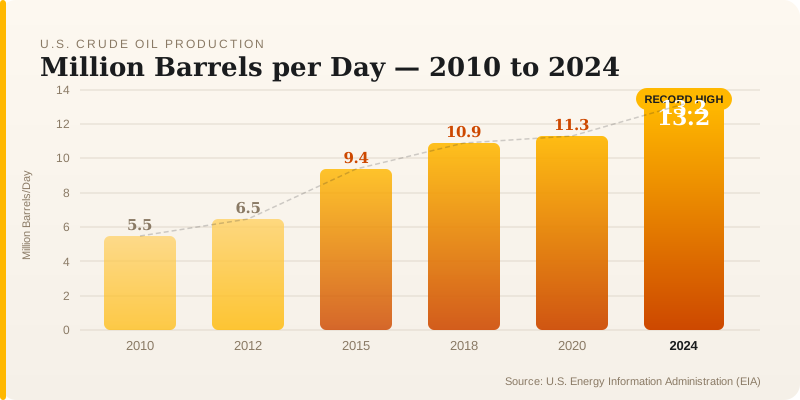
From 5 Million to 13 Million Barrels Per Day
The shale revolution by the numbers:
- In 2008, the US produced approximately 5 million barrels per day of crude oil — a 40-year low
- By 2018, US production exceeded 10 million barrels per day, surpassing Saudi Arabia and Russia to become the world's #1 producer
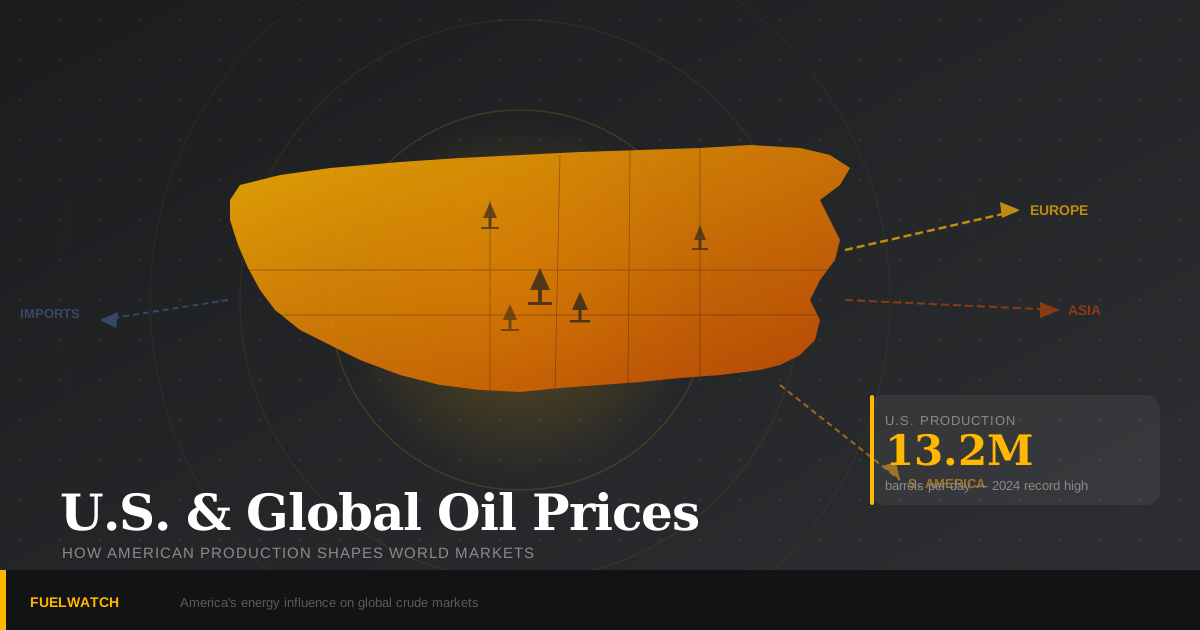
- By 2024, US production reached 13.2 million barrels per day — a record for any nation in history
- The Permian Basin (West Texas and New Mexico) alone produces more oil than most OPEC member nations
- US shale producers can respond to price changes in 4–6 months, compared to 3–5 years for conventional oil projects — creating a natural market stabilizer
- The US now consumes roughly 20 million barrels per day, meaning domestic production covers about two-thirds of consumption
"The US shale revolution is the most significant change to the global oil market since Saudi Arabia opened its taps in the 1970s. It has fundamentally altered the supply-demand balance and OPEC's pricing power." — International Energy Agency (IEA), World Energy Outlook
The "Shale Ceiling": How US Production Limits Price Spikes
One of the most important but least understood ways the US affects global oil prices is through what economists call the "shale cap" — a natural price ceiling created by the responsiveness of US shale production to price signals. When crude oil rises above roughly $60–70 per barrel, the economics of US shale drilling become highly profitable. Drilling rigs are quickly mobilized, new wells are brought online within months, and supply increases — which pushes prices back down.
Why Oil Rarely Stays Above $90 for Long
How the shale ceiling works:
- When oil rises above $70–80/barrel, US shale producers aggressively ramp drilling. The rig count (a leading indicator of future production) typically spikes within 60–90 days of price increases.
- The Permian Basin can add 100,000–200,000 barrels per day of new production within 6 months of a sustained price rise
- This "elastic" supply response is fundamentally different from conventional oil projects that take 5–10 years to develop
- OPEC+ is well aware of this dynamic — production cuts that push prices above $85/barrel tend to incentivize US shale expansion that eventually offsets the cuts
- This is why oil prices, despite significant geopolitical tension in 2023–2024, rarely sustained levels above $95/barrel for extended periods
The Strategic Petroleum Reserve: America's Price Emergency Lever
Created after the 1973 OPEC oil embargo, the Strategic Petroleum Reserve (SPR) is the world's largest government-held emergency oil stockpile. Stored in underground salt caverns along the Gulf Coast, it gives the US government a powerful but finite tool to intervene directly in oil markets during supply emergencies.
America's Oil Emergency Stockpile
Key facts about the SPR and its market impact:
- Located in four salt cavern sites in Texas and Louisiana; can hold up to 714 million barrels
- In 2022, President Biden authorized the release of 180 million barrels — the largest drawdown in SPR history — to offset crude price spikes after Russia's invasion of Ukraine
- That release helped bring US regular gas prices from their June 2022 peak of $5.02/gallon nationally down to below $3.50 by early 2023
- The US can release up to 4.4 million barrels per day from the SPR at maximum draw rate
- SPR releases are most effective when coordinated with the International Energy Agency (IEA), which can trigger emergency stock releases from 30+ member countries simultaneously
- The SPR was drawn down significantly in 2022–2023; replenishment purchases have been ongoing but slow, creating a debate about vulnerability if another crisis hits
"The largest Strategic Petroleum Reserve release in history was a significant factor in bringing gasoline prices down from record highs in 2022. It's one of the most direct tools the federal government has to influence retail fuel costs." — Energy Secretary Jennifer Granholm, 2022
Sanctions: The US as the World's Oil Policeman
The United States has wielded economic sanctions as a foreign policy tool for decades, and few sectors feel those sanctions more directly than global oil markets. By restricting oil exports from Iran, Russia, and Venezuela, the US has effectively removed millions of barrels per day from global supply — raising prices for consumers worldwide, including Americans at the pump.
How US Sanctions Remove Oil from Global Supply
- Iran: Comprehensive US sanctions restrict Iranian oil exports to roughly 1.2–1.5 million barrels per day. Iran's potential export capacity under no sanctions would be 3+ million b/d. Iranian oil that does reach markets (largely via clandestine sales to China) trades at steep discounts.
- Russia: Following the 2022 invasion of Ukraine, the US led a G7 coalition imposing a $60/barrel price cap on Russian oil. The goal was to keep Russian oil flowing globally (preventing a supply shock) while limiting revenue to fund the war. Russian crude now trades at $15–20 discounts to Brent.
- Venezuela: US sanctions on Venezuela's state oil company PDVSA have contributed to a collapse in Venezuelan production from 3.5 million b/d (1998) to under 900,000 b/d
- When the US signals sanctions relief (as with Iran deal negotiations), crude prices often drop $3–7/barrel in anticipation of additional supply before a single barrel reaches a tanker
The Petrodollar: Why the Dollar's Fate Is Tied to Oil
Perhaps the most underappreciated way the US shapes global oil markets is the petrodollar system. Since 1974 — when the Nixon administration reached an agreement with Saudi Arabia to price oil exclusively in US dollars — crude oil has been a dollar-denominated commodity globally. This creates a self-reinforcing relationship: global demand for oil creates global demand for dollars, which in turn allows the US to run large deficits and borrow cheaply.
Why All Oil Is Priced in US Dollars
- Every nation that imports oil must first acquire US dollars — creating permanent global demand for the greenback
- When the Federal Reserve raises or lowers interest rates (affecting dollar strength), it directly moves global crude oil prices by changing the purchasing power of every oil buyer outside the US
- A strong dollar (typically from Fed rate hikes) tends to push crude prices lower; a weak dollar tends to push crude higher
- China, Russia, and others have been working to denominate some oil trade in yuan — so-called "petroyuan" — but the dollar's dominance remains overwhelming as of 2024
- The petrodollar relationship means US monetary policy effectively functions as global energy policy — a unique geopolitical advantage
US LNG Exports: Reshaping the World's Gas Markets
In 2023, the United States became the world's largest exporter of liquefied natural gas (LNG), overtaking Qatar and Australia. This shift has geopolitical and price consequences that extend well beyond natural gas — it affects the global energy transition and, indirectly, oil demand patterns.
America's Newest Energy Influence: Liquefied Natural Gas
- The US exported approximately 91.4 billion cubic feet per month of LNG in 2023, shipping primarily to Europe (to replace Russian pipeline gas) and Asia
- After Russia's invasion of Ukraine, the US became Europe's primary LNG supplier, replacing roughly 40 billion cubic meters of Russian pipeline gas annually
- US LNG exports keep domestic natural gas prices elevated (more gas leaves the US system), but provide the US with massive geopolitical leverage — Europe no longer depends on Russian energy
- When natural gas prices in Europe and Asia spike (as they did in 2022), US LNG exports surge — removing gas from domestic markets and creating upward pressure on US gas and electricity prices, with indirect effects on gasoline demand